Why Do Cats Chirp at Birds? 7 Fascinating Reasons Behind This Cute Cat Behavior, Have you ever watched your cat sitting beside a window, staring at a bird outside, and suddenly making a strange sound that resembles a mixture of a squeak, a chirp, and a tiny chatter? If so, you have probably witnessed one of the most fascinating behaviors in the feline world.
Many cat owners in the United States notice this behavior when their cats watch birds through windows, observe squirrels in the garden, or become excited by movement outdoors. Some cats chirp quietly, while others produce rapid, repeated sounds that make them look as though they are having a conversation with their feathered visitors.
But why do cats chirp at birds?
Cats chirp at birds for several possible reasons, including their natural hunting instincts, excitement, frustration, and responses to moving prey. Although researchers have not established one definitive explanation for every cat’s chirping, this behavior is commonly associated with a cat’s interest in potential prey.
Understanding your cat’s body language and vocalizations can help you learn more about its instincts, emotional state, and everyday needs.
In this guide, we’ll explore seven fascinating reasons cats chirp at birds, explain what this behavior might mean, and share practical ways to keep your indoor cat mentally stimulated and happy.

What Is Cat Chirping?
Cat chirping is a short, high-pitched vocalization that often sounds like a bird’s call. It may resemble a squeak, a quick trill, or a series of rapid clicking sounds. Cats sometimes combine chirping with chattering, meowing, or gentle trilling.
You may notice your cat chirping when it sees birds outside, watches insects moving across a window, or observes a toy that resembles prey.
Unlike a typical meow, which cats frequently use to communicate with humans, chirping often appears during moments of intense visual attention and excitement.
However, every cat is different. Some cats chirp frequently, while others rarely make this sound. Both patterns can be normal.
Common signs that accompany cat chirping
- Focused staring: Your cat fixes its eyes on a bird or another moving object.
- Forward-facing ears: Its ears point toward the source of the movement.
- Rapid jaw movements: Your cat may open and close its mouth quickly while making chattering sounds.
- Tail twitching: The tail tip may flick as your cat concentrates.
- A crouched posture: Your cat may lower its body as though preparing to stalk prey.
These signs can help you understand the situation, but they do not prove exactly what your cat is feeling. Consider the entire body posture rather than relying on one behavior alone.

Why Do Cats Chirp at Birds?
The most likely explanations relate to hunting instincts, excitement, and the stimulation created by watching moving animals. Let’s explore these possibilities in detail.
1. Their Natural Hunting Instincts
Cats are natural predators. Even though domestic cats receive regular meals from their owners, they retain many instincts that helped their ancestors hunt small animals.
Birds naturally attract a cat’s attention because they move quickly, change direction unexpectedly, and sometimes flutter their wings. These movements can activate a cat’s instinctive stalking and tracking behaviors.
When your cat sees a bird outside the window, it may become highly focused on following every movement. Chirping or chattering can occur during this intense period of attention.
For example, imagine your indoor cat sitting on a windowsill while a sparrow lands on a nearby branch. Your cat might lean forward, narrow its eyes, twitch its tail, and produce several quick chirps.
This reaction is consistent with a hunting-related response, even if your cat never gets the opportunity to chase the bird.
Important: Chirping does not necessarily mean your cat is planning to attack. It is one behavior within a much broader collection of feline vocalizations and hunting-related actions.
2. Excitement When Watching Birds
Another possible explanation is excitement.
Birds provide a fascinating source of visual stimulation for indoor cats. Their sudden movements, bright feathers, and unpredictable flight patterns can hold a cat’s attention for long periods.
Some cats respond to this stimulation by chirping, trilling, or chattering.
You might notice that your cat becomes especially vocal when several birds gather near a feeder or when a bird lands close to the window.
Your cat may also move between different windows to continue watching the activity outside.
Although it is tempting to interpret every chirp as happiness, vocalizations alone cannot tell you precisely how your cat feels. Look for other clues, such as relaxed muscles, normal breathing, and an otherwise comfortable posture.
3. Frustration at Not Being Able to Reach the Bird
Indoor cats can watch birds without being able to chase them. For some cats, this situation may create frustration or heightened arousal.
Your cat can see the bird, follow its movements, and perhaps even hear its calls, but the window prevents direct access.
Some cats respond by chattering, pacing, pawing at the glass, or repeatedly returning to the same viewing spot.
If your cat appears tense, repeatedly lashes its tail, or becomes agitated after watching birds, consider redirecting its attention to an interactive toy.
A short play session with a feather wand or another suitable cat toy can provide an outlet for stalking and chasing behaviors.
Never assume that every chirping cat is frustrated, though. Some cats simply observe their surroundings quietly, and others vocalize without showing obvious signs of distress.
Why Cats Chirp at Birds
4. Your Cat Is Reacting to the Bird’s Movements
Cats have excellent visual skills for detecting movement. Even a small bird hopping between branches can capture a cat’s attention.
When your cat watches a bird, its eyes may track every movement. Its head may turn from side to side, and its body may become still as it concentrates.
Chirping may occur during this period of intense observation.
For example, a cat might remain completely silent while a bird sits on a fence but begin chattering when the bird suddenly spreads its wings and flies away.
This reaction is not necessarily a deliberate attempt to communicate with the bird. It may simply occur alongside the cat’s heightened attention and hunting-related excitement.
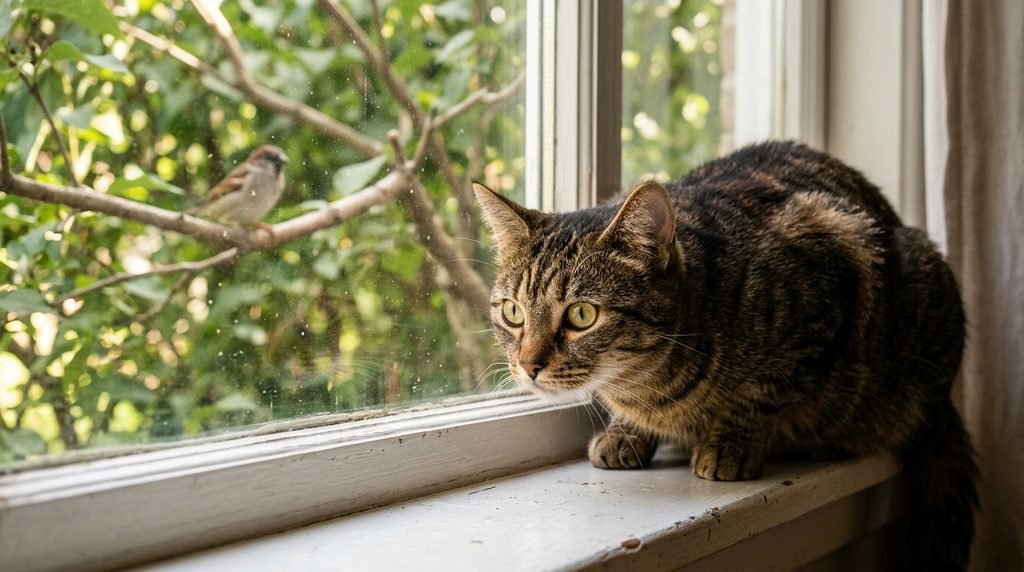
5. Your Cat May Be Practicing Hunting Behaviors
Domestic cats often display hunting-related behaviors even when they do not need to hunt for food.
Stalking, crouching, tracking, pouncing, and chasing are natural parts of feline behavior. Watching birds can provide an opportunity for cats to engage their attention and practice some of these instinctive movements.
Chirping sometimes appears alongside these behaviors, although scientists have not established that it serves a specific hunting-training purpose.
You may observe your cat:
- Crouching low while watching a bird.
- Moving its head slowly to track the bird.
- Flicking the tip of its tail.
- Shifting its weight as if preparing to pounce.
- Making short, repeated chirping sounds.
These behaviors can be especially noticeable in young cats, but adult cats may display them throughout their lives.
How you can help: Provide short, supervised interactive play sessions using toys that move like prey. Allow your cat to stalk, chase, and occasionally catch the toy to make play more rewarding.
6. Your Cat May Be Responding to Sounds
Birds produce a variety of calls, whistles, and chirps. Cats have sensitive hearing and can detect many high-frequency sounds that humans may not notice as easily.
When your cat hears birds outside, it may turn its ears toward the sound, look around for its source, or move closer to the window.
Some cats vocalize during these moments of attention.
However, a cat chirping at a bird does not necessarily mean it is imitating the bird’s call. Although that idea is popular among cat owners, the precise purpose of chirping remains uncertain.
To learn what triggers your cat’s behavior, observe whether it chirps when birds are visible, when their calls can be heard without being seen, or when other moving objects capture its attention.
Never play loud bird sounds just to provoke a reaction. Your cat should always have the option to move away from sounds or other stimulation that makes it uncomfortable.
Chirping May Be Part of Your Cat’s Individual Personality
Just as people have different ways of expressing themselves, cats have individual vocal habits.
Some cats frequently chirp, trill, or chatter. Others communicate mainly through body language or ordinary meows.
Breed, age, early experiences, environment, and individual temperament may influence how vocal a cat is, but no single factor explains every cat’s behavior.
For instance, one cat might chirp every morning while watching sparrows in the garden. Another might watch the same birds silently for several minutes.
Neither behavior is automatically a cause for concern.
If your cat has always chirped while watching birds and otherwise eats, plays, breathes, and behaves normally, the sound is generally nothing to worry about.
However, if the vocalization is new, persistent, or accompanied by signs of discomfort, pay attention to the circumstances and consider consulting a veterinarian.
Why Do Indoor Cats Chirp Through Windows?
Indoor cats often have fewer opportunities to encounter wildlife directly. Windows provide a safe way to observe outdoor activity, making them an important source of environmental stimulation.
A window overlooking trees, gardens, or bird feeders can become a favorite viewing spot.
Your cat may spend time watching birds, squirrels, passing leaves, or insects. These sights offer opportunities to observe movement and engage natural curiosity.
How to create a cat-friendly window area

- Provide a secure window perch: Choose a stable perch that can safely support your cat’s weight.
- Keep windows secure: Make sure screens are firmly attached and windows cannot open wide enough for your cat to escape.
- Offer a comfortable resting place: A soft bed or blanket can make the viewing area more inviting.
- Create a stimulating environment: Rotate toys and provide scratching posts, climbing spaces, and hiding places.
- Protect visiting birds: Place bird feeders away from areas where outdoor cats can ambush birds, and supervise access to outdoor spaces.
Remember that not every cat enjoys watching birds. Let your cat choose whether to use the window area rather than forcing it to remain there.
Is Cat Chirping a Sign of Happiness or Frustration?
It can accompany excitement, intense concentration, or frustration, but chirping alone cannot reliably distinguish between these emotional states.
Observe your cat’s complete body language.
| Behavior | What it may suggest |
|---|---|
| Relaxed posture and curious observation | Comfortable interest |
| Fixed gaze and crouching | Focused attention or hunting-related behavior |
| Rapid tail movements and pacing | Heightened arousal or possible frustration |
| Hiding, flattened ears, or tense posture | Stress or discomfort |
| Sudden unusual vocalization with signs of pain | A possible medical concern |
These are general clues, not definitive diagnoses. Context matters, and individual cats behave differently.
If your cat becomes increasingly agitated while watching birds, gently redirect its attention with a toy or offer access to a quiet room.
Cat Chirping, Care Tips, and FAQs
How to Keep Your Cat Happy and Mentally Stimulated
Watching birds can provide valuable enrichment, but cats also need opportunities to play, explore, climb, scratch, and interact with their environment.
If your cat regularly chirps at birds through the window, try these practical activities to support its physical and mental well-being.

1. Schedule Interactive Playtime
Use a feather wand, toy mouse, or another cat-safe toy to encourage stalking, chasing, and pouncing.
Try several short play sessions throughout the day, adjusting their length to your cat’s age, energy level, and preferences.
Move toys in ways that encourage your cat to follow and catch them. Store wand toys safely when playtime ends.
2. Provide Puzzle Feeders
Puzzle feeders encourage cats to work for small portions of their food. They can provide mental stimulation and introduce variety into daily feeding routines.
Start with an easy puzzle and gradually introduce more challenging options as your cat becomes comfortable.
Always make sure your cat can access enough food and does not become frustrated by a puzzle that is too difficult.
3. Create Opportunities for Climbing
Cat trees, sturdy shelves designed for cats, and elevated resting areas let cats explore their surroundings from different heights.
Make sure climbing structures are stable and positioned away from hazards such as unsecured windows.
4. Rotate Your Cat’s Toys
Cats may lose interest in toys that remain in the same place for long periods. Try rotating several safe toys every few days to introduce variety.
Different textures, shapes, and movement patterns may appeal to different cats.
5. Allow Your Cat to Observe Wildlife Safely
A secure window perch can provide hours of entertainment without exposing your indoor cat to outdoor dangers.
Keep windows and screens secure, and never leave a cat unattended on an unsafe balcony or near an open window.
When Should You Worry About Your Cat’s Chirping?
Most chirping associated with watching birds is harmless. Nevertheless, changes in vocalization can sometimes signal discomfort or a medical problem.
Contact your veterinarian if your cat suddenly develops unusual or persistent vocalizations, especially when accompanied by changes in appetite, activity, or behavior.
Seek prompt veterinary attention if chirping occurs alongside signs such as:
- Repeated coughing or gagging.
- Difficulty swallowing.
- Obvious pain or distress.
- Unusual lethargy or refusal to eat.
Emergency warning: If your cat is struggling to breathe, breathing with its mouth open at rest, or showing blue or gray gums, seek emergency veterinary care immediately. Do not assume these signs are ordinary chirping.
A veterinarian can help determine whether the sound is a normal vocalization or related to a health concern.
Frequently Asked Questions About Cats Chirping at Birds
1. Why does my cat chirp at birds through the window?
Cats may chirp because birds trigger their hunting instincts, attract their attention, or create excitement or frustration. The precise reason varies from cat to cat.
2. Is it normal for cats to chirp at birds?
Yes. Chirping and chattering are common feline vocalizations, particularly when cats watch moving animals. If your cat otherwise behaves normally, this is usually not concerning.
3. Does chirping mean my cat wants to catch a bird?
It may reflect hunting-related attention, but chirping alone does not prove your cat intends to catch the bird. Observe its posture and other behaviors for additional clues.
4. Why does my cat chatter its teeth at birds?
Some cats make rapid jaw movements and clicking sounds while watching prey. This is commonly called chattering. Its exact purpose is uncertain, and it should not be confused with persistent teeth grinding or signs of oral pain.
5. Do all cats chirp at birds?
No. Some cats chirp frequently, while others remain silent. Both can be normal expressions of individual behavior.
6. Should I stop my cat from chirping?
Usually not. If your cat appears comfortable, there is generally no need to stop the behavior. If it becomes distressed or agitated, redirect its attention gently with a toy or another enjoyable activity.
7. Can indoor cats benefit from watching birds?
Yes. Watching wildlife can provide visual stimulation and encourage curiosity. Combine window watching with interactive play, climbing opportunities, scratching surfaces, and other forms of enrichment.
Final Thoughts: Enjoy Your Cat’s Fascinating Bird-Watching Behavior
Cat chirping is one of the many behaviors that make feline companions so interesting. When your cat watches a sparrow outside the window and responds with a series of tiny squeaks or chattering sounds, it may be expressing intense interest, excitement, or hunting-related arousal.
Although the exact reason for chirping is not fully understood, this behavior is generally normal when it occurs in an otherwise healthy cat.
You can support your cat by providing safe window access, interactive toys, climbing spaces, and opportunities to explore its environment. Pay attention to body language, too, because it can help you recognize when your cat is comfortable and when it needs a break.
Above all, remember that every cat has its own personality. Some are naturally vocal, while others prefer to observe the world quietly.
Understanding these differences can help you build a stronger relationship with your feline companion.
For more practical cat behavior and pet-care advice, visit PetZuoo.com, where we help pet owners make informed decisions about their dogs and cats.

hammadniazi6663@gmail.com
Contributor at PetZuoo, publishing practical information for pet owners and animal lovers.
Related guides

Why Do Dog Tilt Their Heads? 9 Fascinating Reason
Why Do Dog Tilt Their Heads? 9 Fascinating Reason Behind This Adorable Behavior. Have you ever spoken to your dog and watched…
Cat Chattering at Birds: 7 Amazing Reasons Explained
Cat Chattering at Birds: 7 Amazing Reasons Explained. Have you ever noticed your cat sitting beside a window, watching birds outside, and…
Why Do Cats Follow You Everywhere? 9 Surprising Reason
Why Do Cats Follow You Everywhere? 9 Surprising Reason and Have you ever walked into the kitchen and noticed your cat right…