Why Does Your Dog’s Ear Smell Bad? 9 Critical Sign and Why Is My Dog’s Ear Smelling Bad? 9 Warning Signs You Should Never Ignore. A dog’s ears can tell you a lot about their overall health. If you regularly cuddle, groom, or play with your dog, you may eventually notice something unusual about their ears. One of the most common warning signs is an unpleasant smell.
So, why does a dog’s ear smell bad?
A mild, natural ear smell can sometimes be normal. However, a strong, unpleasant, sour, yeasty, or rotten smell may indicate a problem that needs attention. Ear infections, excessive wax, allergies, trapped moisture, parasites, foreign objects, and other conditions can all contribute to an unusual odour.
The good news is that noticing the problem early can make it much easier to manage. Your dog may also show other signs, such as scratching, head shaking, redness, swelling, discharge, or sensitivity around the ears.
In this guide, we will explain the most common reasons your dog’s ear smells bad, the warning signs you should watch for, what you can safely do at home, and when it is time to contact a veterinarian.

What Does a Healthy Dog Ear Smell Like?
Before worrying about an unusual smell, it helps to understand what normal looks like.
Healthy dog ears usually have very little noticeable odour. The skin inside the outer ear should generally look clean and relatively calm, although some dogs naturally produce a small amount of wax.
A healthy ear should not normally have:
- A strong rotten smell
- A powerful sour or yeasty odour
- Large amounts of dark discharge
- Thick yellow or green fluid
- Significant redness
- Swelling
- Bleeding
- Severe wax buildup
- Persistent moisture
Every dog is different. Some dogs naturally have more earwax than others, especially breeds with floppy or hairy ears. However, a sudden change in smell is more important than a slight natural odour.
If your dog’s ears normally have almost no smell and suddenly develop a strong odour, pay attention to the change.
Why Does My Dog’s Ear Smell Bad?
There is no single cause of a bad-smelling dog ear. Several different problems can produce similar symptoms.
Some common causes include ear infections, allergies, moisture, excessive wax, parasites, and foreign material.
Let’s look at them in more detail.
1. Ear Infection
An ear infection is one of the most common reasons a dog’s ear may develop a strong unpleasant smell.
Dogs can develop infections involving different microorganisms, including yeast and bacteria. Sometimes both can be present at the same time.
An infected ear may also become:
- Red
- Warm
- Swollen
- Painful
- Moist
- Dirty-looking
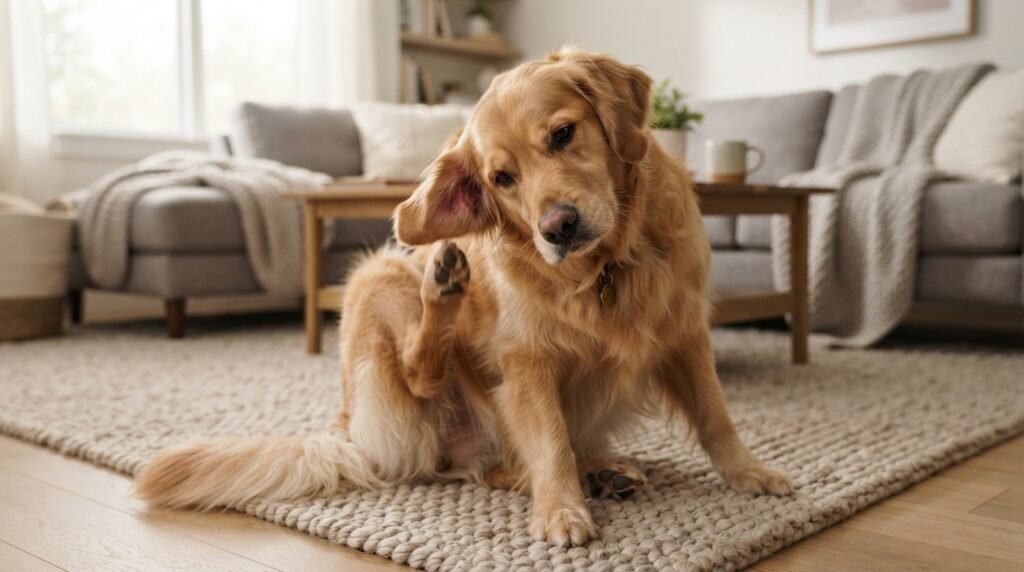
You may notice your dog scratching one or both ears more frequently. They may also shake their head repeatedly or rub their ear against furniture or the floor.
The smell can vary depending on the underlying problem. Some owners describe it as sour, musty, cheesy, or unusually strong.
An important point is that an ear infection is not something you should try to diagnose by smell alone. Different conditions can look similar, and proper treatment depends on identifying the underlying cause.
2. Yeast Overgrowth
Yeast naturally exists on the skin, but problems can occur when it grows excessively.
Yeast-related ear problems may produce a noticeable musty or sweetish odour. The ear may also contain dark brown debris or wax.
Your dog may scratch the ear frequently or become uncomfortable when you touch it.
Dogs with allergies or other skin problems can be particularly prone to recurring ear issues. If your dog repeatedly develops smelly ears, treating only the immediate symptoms may not solve the bigger problem.
A veterinarian can help determine whether yeast is involved and whether an underlying condition is contributing to repeated episodes.
3. Bacterial Infection
Bacteria can also contribute to unpleasant ear odour.
A bacterial ear problem may be accompanied by inflammation, pain, discharge, and redness. In more severe cases, the ear can become extremely uncomfortable.
If your dog cries, pulls away, or becomes unusually defensive when you touch the ear, do not force an examination at home.
Pain can make even a normally gentle dog react differently.
Because bacterial infections can require specific treatment, veterinary evaluation is important when an infection is suspected.
4. Excessive Earwax
Not every smelly ear means your dog has a serious infection.
Some dogs naturally produce more wax than others. If wax accumulates, it can trap moisture and debris and create an environment where microorganisms can multiply.
Excessive wax may appear:
- Brown
- Yellowish
- Dark
- Sticky
- Crusty
A small amount of wax can be normal, but a sudden increase accompanied by a strong smell, itching, redness, or discharge deserves attention.
Avoid digging deep into your dog’s ear to remove wax. The ear canal is delicate, and inserting objects too deeply can cause injury.
5. Moisture Trapped Inside the Ear
Water is another common contributor to ear problems.
Dogs that frequently swim or receive baths can sometimes retain moisture in their ears. Moisture trapped in a warm ear canal can create favourable conditions for microorganisms to grow.
This is particularly important for dogs with floppy ears because their ear flaps can reduce airflow.
After swimming or bathing, gently dry the visible outer part of your dog’s ears with a clean towel.
Do not push cotton swabs deep into the ear canal.
If your dog frequently develops ear problems after swimming, talk with your veterinarian about an appropriate ear-care routine for your individual dog.

6. Allergies
Allergies can play a major role in recurring ear problems.
Some dogs experience environmental allergies related to things such as pollen, dust, or other environmental triggers. Food allergies or sensitivities may also be associated with skin and ear problems in some dogs.
An allergic dog may have:
- Itchy ears
- Itchy paws
- Red skin
- Repeated ear infections
- Skin irritation
- Excessive licking or scratching
If your dog’s ear problems keep returning, it is worth discussing the pattern with a veterinarian rather than repeatedly treating each episode as an isolated infection.
Finding and managing the underlying cause can be an important part of long-term ear health.
7. Ear Mites
Ear mites are tiny parasites that can affect dogs, although they are more commonly associated with cats.
They can cause intense itching and irritation. Dogs with ear mites may scratch their ears frequently and shake their heads.
Dark, crumbly debris may sometimes be visible inside the ear.
Because several ear conditions can create similar-looking debris, it is best not to assume that dark material automatically means ear mites.
A veterinarian can examine the ear and determine what is actually causing the problem.
8. A Foreign Object
Sometimes the problem begins with something that becomes trapped in or around the ear.
Grass seeds, plant material, dirt, or other small objects can irritate the ear.
This may happen suddenly, particularly after a walk outdoors.
Your dog may suddenly begin:
- Shaking their head
- Scratching one ear
- Tilting their head
- Rubbing the side of their face
- Showing signs of pain
If the problem appears suddenly and affects only one ear, a foreign object is one possibility worth considering.
Do not try to dig around inside the ear with tweezers or other objects unless a veterinarian has specifically instructed you to do so.
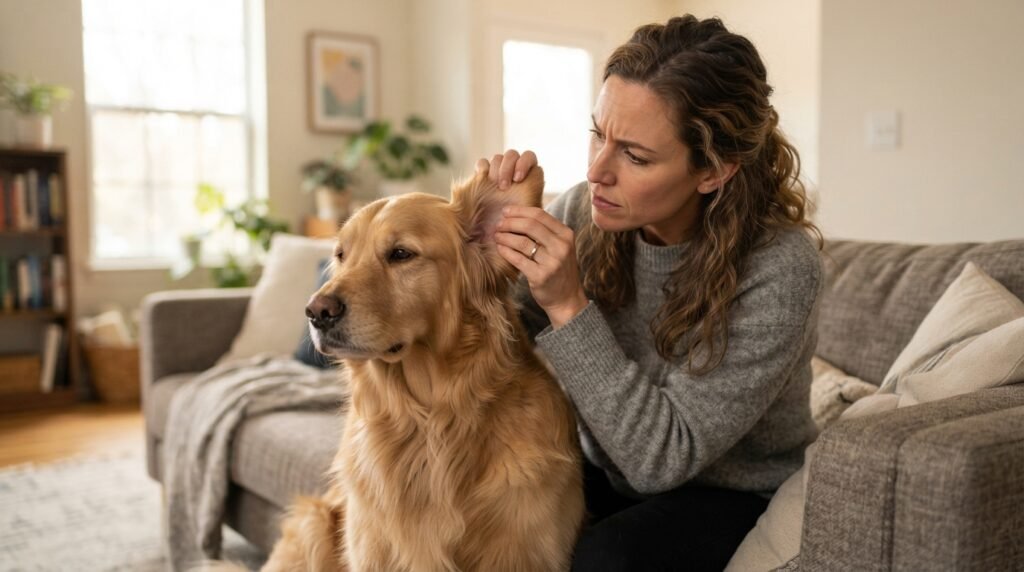
9. A Deeper Ear Problem
Sometimes the visible part of the ear does not tell the whole story.
A problem can involve deeper portions of the ear canal, and signs may become more serious when inflammation or infection progresses.
A dog with a deeper ear problem may develop:
- Persistent head shaking
- Severe pain
- Head tilting
- Balance problems
- Difficulty walking normally
- Significant discharge
- Reduced response to sounds
These symptoms require prompt veterinary attention.
9 Warning Signs You Should Never Ignore
A bad smell alone does not always tell you how serious a problem is. Look at the entire picture.
Warning Sign #1: Strong or Sudden Odour
If your dog’s ear suddenly develops a powerful unpleasant smell, investigate the cause.
A noticeable change is especially important if the smell continues or becomes stronger.
Warning Sign #2: Constant Head Shaking
Occasional head shaking is normal.
Repeated head shaking throughout the day is different.
Persistent shaking may indicate irritation, inflammation, pain, or something trapped in the ear.
Warning Sign #3: Excessive Scratching
If your dog repeatedly scratches the same ear, do not simply assume it is a habit.
Frequent scratching can cause additional skin damage and make an existing ear problem worse.
Warning Sign #4: Redness or Swelling
Healthy ear tissue should not normally be severely red or swollen.
Inflammation can be a sign that something is irritating the ear.
Warning Sign #5: Unusual Discharge
Watch for discharge that is thick, excessive, bloody, yellow, green, or significantly different from your dog’s normal earwax.
Discharge combined with odour is particularly worth getting checked.
Warning Sign #6: Pain When You Touch the Ear
If your dog suddenly pulls away, cries, growls, or tries to stop you from touching the ear, take the pain seriously.
Do not force the ear open for a closer look.
Warning Sign #7: Head Tilting
A persistent head tilt can indicate a more significant ear problem.
Because balance-related symptoms can sometimes involve deeper parts of the ear, veterinary assessment is important.
Warning Sign #8: Loss of Balance
Stumbling, falling, walking unusually, or appearing dizzy is not a normal sign of simple earwax buildup.
Seek veterinary care promptly if these symptoms occur.
Warning Sign #9: The Problem Keeps Coming Back
Recurring smelly ears deserve more than repeated cleaning.
If your dog develops ear problems again and again, there may be an underlying reason, such as allergies, ear anatomy, moisture, or another health issue.

Dog Ear Infection vs. Normal Ear Wax
One of the biggest challenges for dog owners is knowing when earwax is normal and when it may indicate a problem.
A small amount of wax can be normal.
However, the combination of strong odour + redness + itching + discharge + discomfort is much more concerning than ordinary wax alone.
Do not judge your dog’s ear health based on colour alone. Dark material can have different causes, and appearance by itself cannot reliably identify the underlying problem.
Instead, look at the overall symptoms.
If your dog is comfortable, the ear is not inflamed, and there is only a small amount of normal-looking wax, you may simply need to monitor it.
If several warning signs appear together, contact your veterinarian.
What Can You Safely Do at Home?
If your dog’s ear is mildly dirty but your dog is comfortable and there are no signs of serious irritation, basic ear hygiene may help.
First, inspect only the visible outer portion of the ear.
Use a veterinarian-recommended dog ear-cleaning solution if your veterinarian has advised that routine cleaning is appropriate for your dog.
Apply the product according to its label or your veterinarian’s instructions.
Gently massage the base of the ear if instructed, then allow your dog to shake their head. Wipe away loosened debris from the visible outer ear with clean cotton or gauze.
Never force anything deep into the ear canal.
The goal of routine cleaning is not to make the ear completely free of every trace of wax. Healthy ears have natural protective mechanisms, and excessive cleaning can sometimes irritate the skin.
What You Should Never Put in Your Dog’s Ear
Online advice sometimes recommends household ingredients for dog ear problems.
Be careful.
Avoid putting substances into your dog’s ear unless a veterinarian has specifically recommended them.
Do not experiment with:
- Undiluted vinegar
- Hydrogen peroxide
- Alcohol
- Essential oils
- Household cleaners
- Human ear medications
- Random antibiotic creams
- Homemade mixtures
A damaged eardrum can change which products are safe.
You may not know whether your dog’s eardrum is intact without a veterinary examination.
Something that appears harmless can potentially cause additional irritation or complications.
When Should You Call a Veterinarian?
Contact your veterinarian if your dog’s ear smells bad and the smell is accompanied by other symptoms.
You should be especially proactive if your dog has:
- Significant pain
- Severe redness
- Swelling
- Heavy discharge
- Bleeding
- Persistent scratching
- Constant head shaking
- Head tilting
- Balance problems
- Sudden hearing changes
- Repeated ear infections
If your dog seems extremely uncomfortable or develops neurological or balance-related symptoms, seek veterinary attention promptly.
Young puppies, older dogs, and dogs with recurring health problems may also need a more careful evaluation.
How Veterinarians Diagnose Ear Problems
A veterinarian may begin by examining the outside of the ear and looking into the ear canal with an otoscope.
Depending on the situation, they may also examine material from the ear under a microscope.
This can help identify whether yeast, bacteria, parasites, or other abnormalities may be involved.
Treatment depends on the cause.
That is why using leftover medication from a previous ear infection is not always a good idea. The current problem may have a different cause, and the wrong treatment could delay appropriate care.
How to Help Prevent Future Ear Problems
You cannot prevent every ear problem, but a few habits can support healthier ears.
Check Your Dog’s Ears Regularly
Take a quick look at your dog’s ears during normal grooming.
You are looking for changes such as redness, swelling, excessive wax, discharge, or an unusual smell.
Early detection can make it easier to address problems before they become more uncomfortable.
Keep the Outer Ear Dry
After swimming or bathing, gently dry the visible outer ear.
Do not push towels or other materials deeply into the ear.
Follow a Sensible Cleaning Routine
Some dogs need regular cleaning, while others do not need frequent cleaning at all.
Your dog’s breed, ear shape, skin health, lifestyle, and history of ear problems can all influence their needs.
Ask your veterinarian what routine is appropriate.
Manage Underlying Allergies
If your dog repeatedly develops ear problems, discuss allergies and other possible underlying causes with your veterinarian.
Treating recurring infections without addressing contributing factors may lead to a cycle of temporary improvement followed by another episode.
Keep Grooming Gentle
If your dog’s ears contain excessive hair, ask a professional about appropriate grooming rather than aggressively removing hair yourself.
Overhandling or irritating the ear canal can create additional problems.
Why Floppy-Eared Dogs May Need Extra Attention
Some dogs have ear shapes that reduce airflow around the ear canal.
Breeds with long, floppy ears can retain warmth and moisture more easily than dogs with upright ears.
However, ear problems are not limited to floppy-eared breeds.
Any dog can develop an ear problem.
The important thing is to understand your own dog’s normal ears so you can recognize changes quickly.
Can a Bad-Smelling Ear Go Away on Its Own?
Sometimes a mild odour may disappear after routine grooming or once temporary moisture has dried.
But a persistent or worsening smell should not simply be ignored.
If there is an infection, foreign object, allergy-related inflammation, or another underlying problem, the smell may continue until the actual cause is addressed.
Instead of repeatedly masking the odour with cleaning products, pay attention to what else is happening.
The smell is a clue, not a diagnosis.
Frequently Asked Questions
Why does my dog’s ear smell like cheese?
A strong cheesy, sour, or musty smell can occur with certain ear problems, including yeast overgrowth or bacterial involvement. However, smell alone cannot identify the cause. If the odour is persistent or accompanied by itching, redness, discharge, or pain, contact your veterinarian.
Why does my dog’s ear smell but look clean?
An ear can have an unpleasant smell even when you cannot see obvious debris. The problem may be deeper inside the ear canal or related to inflammation. A veterinary examination can provide a more accurate answer.
Can I clean my dog’s smelly ear at home?
If your veterinarian has recommended routine cleaning for your dog and there are no signs of severe pain or injury, you may be able to clean the visible ear using an appropriate veterinary ear-cleaning product. Avoid inserting objects deeply into the ear.
How often should I clean my dog’s ears?
There is no single schedule that works for every dog. Some dogs need more frequent cleaning, while others can become irritated if cleaned too often. Ask your veterinarian what schedule is appropriate for your dog.
Is dark earwax always an infection?
No. Dark debris can have different causes. Colour alone cannot reliably diagnose an infection, parasites, or another condition. Other symptoms and veterinary examination may be necessary.
Why does my dog’s ear keep getting infected?
Recurring ear problems can have underlying contributors such as allergies, moisture, ear anatomy, parasites, or other skin conditions. If infections keep returning, discuss the pattern with your veterinarian.
Can swimming cause a dog’s ears to smell?
Swimming can contribute to moisture remaining in the ear, which may increase the risk of irritation or microbial overgrowth in some dogs. Keeping the visible outer ear dry after swimming can help, but dogs with recurring problems may need a veterinarian-recommended preventive routine.
Should I use human ear drops on my dog?
Do not use human ear medication unless your veterinarian specifically tells you to. Dog ear problems can have different causes, and some medications may not be appropriate in certain circumstances.

Final Thoughts
If your dog’s ear smells bad, don’t panic—but don’t ignore the change either.
A mild natural odour may not be a serious concern, but a strong or persistent smell can be an early clue that something is wrong. Pay attention to the complete picture, including scratching, head shaking, redness, swelling, discharge, pain, and changes in your dog’s behaviour.
The safest approach is to avoid guessing at the cause. Do not use harsh household products or insert objects deep into your dog’s ear. If the smell continues or your dog shows other warning signs, speak with your veterinarian.
Your dog’s ears may be small, but they deserve regular attention. A few seconds of checking during grooming can help you notice changes early and potentially prevent a minor issue from becoming a much more uncomfortable problem.
Most importantly, remember that a bad smell is a symptom, not a diagnosis. Understanding what your dog normally looks and smells like is one of the simplest ways to recognize when professional help may be needed.
10. A Simple Daily Ear-Check Routine for Your Dog
You don’t need to spend a long time examining your dog’s ears every day. A quick routine can help you notice changes before they become obvious problems.
Start by choosing a calm moment when your dog is relaxed. Gently lift the ear flap and look at the visible area. You are checking for anything different from normal.
Look for:
- New redness
- Swelling
- Excessive wax
- Unusual discharge
- Crusts
- Moisture
- Scratching
- A new unpleasant smell
You should also pay attention to your dog’s reaction. If your dog normally allows you to touch their ears but suddenly pulls away, that change may be important.
Don’t Over-Clean Your Dog’s Ears
One common mistake is thinking that cleaner ears are always healthier ears.
That isn’t necessarily true.
Dogs naturally produce earwax, and the ear has its own protective mechanisms. Cleaning too frequently or aggressively may irritate the skin and potentially make an existing problem worse.
Instead of cleaning according to a fixed schedule simply because you read one online, consider your dog’s individual needs.
A dog that swims frequently or has a history of ear problems may have different requirements from a dog with naturally clean, dry ears.
Your veterinarian can recommend an appropriate routine.
Pay Attention to One-Sided Problems
If your dog suddenly develops a problem in only one ear, don’t automatically assume it is a routine infection.
One-sided symptoms can sometimes occur when something has entered the ear or when another localized problem is present.
For example, after walking through tall grass, your dog may suddenly begin shaking their head or scratching one ear.
If the symptoms appear suddenly, particularly with pain, have the ear examined rather than trying to investigate deeply yourself.
Don’t Ignore Repeated Head Shaking
Every dog shakes their head occasionally.
Repeated head shaking is different.
If your dog is shaking their head many times throughout the day, something may be irritating the ear.
The longer the dog scratches and shakes, the greater the opportunity for additional irritation. Vigorous scratching can also injure the skin around the ear.
If persistent head shaking continues, veterinary advice is appropriate.
What About Ear Hair?
Ear hair can be a confusing subject for dog owners.
Some breeds naturally have more hair around the ears, and owners may wonder whether removing it will prevent infections.
There is no universal rule that every dog’s ear hair should be removed.
Aggressive plucking or pulling can irritate the ear canal and create inflammation.
Instead, ask your veterinarian or an experienced professional groomer whether your particular dog’s ear hair requires attention.
The goal should always be healthy ears—not simply hair-free ears.
Your Dog’s Behaviour Can Reveal an Ear Problem
Sometimes the first sign isn’t something you see inside the ear.
It may be a change in behaviour.
A dog with an uncomfortable ear may become less interested in being touched around the head. They might avoid grooming, stop enjoying ear scratches, or become unusually irritable.
Some dogs become quieter when they are uncomfortable, while others become restless.
If your dog’s personality suddenly changes alongside a bad-smelling ear, take the combination seriously.
Keep a Record of Recurring Ear Problems
If your dog has had multiple ear problems, keeping a simple record can be surprisingly useful.
Write down:
- When the problem started
- Which ear was affected
- What symptoms appeared
- Whether there was discharge
- Whether your dog was scratching
- Whether swimming happened recently
- What treatment was prescribed
- How long improvement took
- When the problem returned
This information can help your veterinarian identify patterns.
For example, you may discover that your dog’s ear problems repeatedly appear after certain seasonal changes or activities.

The Bigger Picture: Healthy Skin and Healthy Ears
Ear health is often connected with overall skin health.
If your dog frequently scratches their paws, rubs their face, licks their body, or develops irritated skin alongside recurring ear problems, tell your veterinarian.
A dog experiencing repeated ear inflammation may have a broader skin issue that needs attention.
Treating the ear alone may provide temporary relief without addressing why the problem keeps returning.
When an Emergency May Be Needed
Most smelly-ear problems are not emergencies, but certain symptoms should be treated more urgently.
Seek prompt veterinary attention if your dog develops severe pain, significant bleeding, major swelling, sudden balance problems, persistent head tilting, or other unusual neurological signs.
Do not wait several days to see whether severe symptoms disappear on their own.
Final Takeaway
Your dog’s ear smell is worth paying attention to because changes can sometimes be an early warning sign.
Don’t rely on smell alone. Look at the entire picture.
A healthy-looking, comfortable ear with minimal wax is very different from an ear that smells strongly, looks red, produces discharge, and causes your dog to scratch or shake their head.
When in doubt, professional veterinary advice is the safest choice.
A few minutes of regular observation can help you become familiar with your dog’s normal ears—and that makes it much easier to recognize when something has changed.
Practical Prevention & Care
11. How to Build a Better Ear-Care Routine
Good ear care doesn’t mean constantly cleaning your dog’s ears. It means checking them regularly, recognizing changes, and responding appropriately.
Choose a calm time when your dog is relaxed. Gently lift the ear flap and look at the visible portion. You don’t need to push anything into the ear canal.
A quick check can help you notice:
- Unusual smell
- Redness
- Swelling
- Excessive wax
- Discharge
- Moisture
- Crusting
- Signs of pain
If everything looks normal and your dog is comfortable, there may be no reason to clean the ears at that moment.
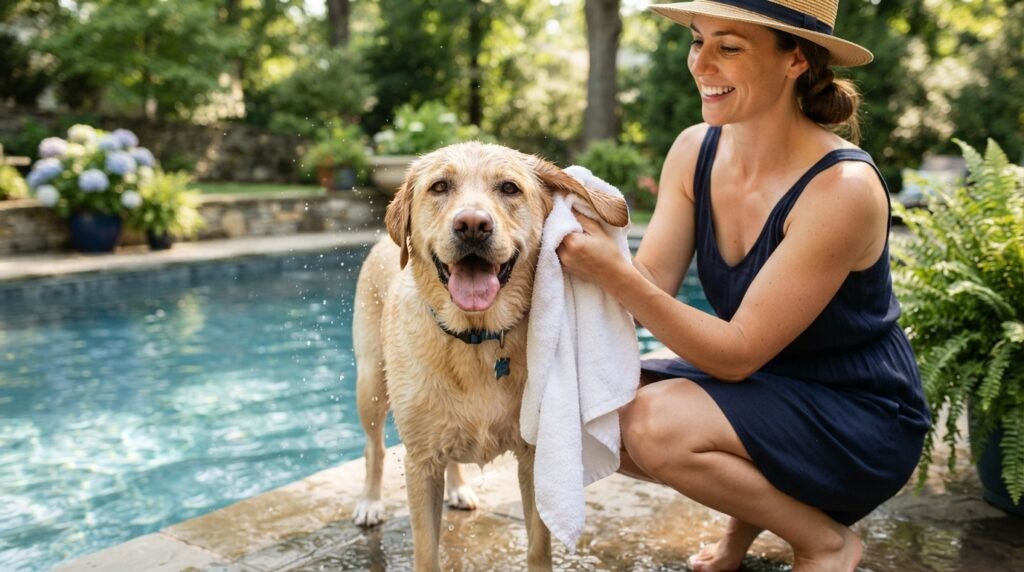
12. Be Extra Careful After Swimming
Swimming can be enjoyable for dogs, but moisture left around the ears may contribute to irritation in some dogs.
After your dog swims, gently dry the outside of the ears with a clean towel. Pay attention to dogs with floppy ears because their ear flaps can reduce airflow.
However, don’t try to dry the deep ear canal with cotton swabs or other objects.
If your dog regularly develops ear problems after swimming, ask your veterinarian whether a preventive ear-care product is appropriate.
13. Grooming Can Support Ear Health
Regular grooming gives you another opportunity to notice changes.
While brushing your dog, check the ears for anything unusual. If your dog’s ears are surrounded by excessive hair, discuss grooming options with a professional.
Avoid aggressively pulling or plucking hair from the ear canal without professional guidance. Irritating sensitive ear tissue can potentially create more problems.
14. Don’t Share Ear Medication Between Dogs
If one dog in your household has an ear infection, it doesn’t mean another dog with similar symptoms should receive the same medication.
Different ear problems can require different treatments.
Even if two dogs have similar-looking discharge or smell, the underlying causes may be different.
Never use leftover medication simply because it worked for another pet in the past. Your veterinarian can determine whether medication is actually needed and which treatment is appropriate.
15. Avoid the “Wait and See” Trap
Many owners initially notice a strange smell and think:
“I’ll clean it today and see what happens.”
Sometimes that is reasonable for a mildly dirty ear when the dog is otherwise completely comfortable.
But if the smell is strong, persistent, or accompanied by pain, discharge, redness, scratching, or repeated head shaking, repeatedly waiting can allow the underlying problem to continue.
Early veterinary evaluation can help prevent a minor issue from becoming more complicated.
16. Why Your Dog’s Ear Smell May Change Suddenly
A sudden change is often more meaningful than a long-standing mild odour.
For example, if your dog’s ears have always smelled normal and you suddenly notice a strong unpleasant smell, something may have changed.
Possible contributors include:
- Moisture
- Increased wax production
- Inflammation
- Infection
- Allergies
- Parasites
- Foreign material
You don’t need to determine which one is responsible yourself.
Your job as a pet owner is to recognize the change and decide whether professional evaluation is needed.
17. Don’t Judge an Ear Problem Only by Appearance
An ear can look relatively normal from the outside while still causing discomfort.
Likewise, an ear can contain some wax without having an infection.
This is why smell, appearance, and behaviour should be considered together.
Ask yourself:
Does my dog seem comfortable?
Has the smell changed?
Is there discharge?
Is my dog scratching?
Is there redness or swelling?
Is my dog shaking their head more than usual?
The more warning signs appear together, the stronger the reason to contact your veterinarian.
18. What Responsible Dog Owners Should Remember
You don’t need to become an expert in veterinary medicine to protect your dog’s ears.
You simply need to know your dog’s normal condition.
If you regularly observe your dog’s ears during grooming, changes become easier to spot.
Instead of waiting until your dog is constantly scratching, learn what normal looks like today.
That small habit can make a significant difference.
19. A Simple Rule to Remember
Here’s an easy rule for dog owners:
Smell alone deserves attention. Smell plus symptoms deserves action.
If your dog’s ears smell slightly different but everything else looks normal, monitor the situation and consider discussing it with your veterinarian if it persists.
If the bad smell comes with pain, discharge, redness, swelling, constant scratching, head shaking, head tilting, or balance problems, don’t ignore it.
20. Final Thoughts for Pet Parents
Your dog cannot tell you, “My ear hurts.”
Instead, they communicate through behaviour.
A strong smell, repeated scratching, head shaking, rubbing the face, or avoiding touch may be their way of showing that something isn’t right.
The best approach is simple: observe, don’t panic, and don’t experiment with potentially harmful home remedies.
Keep your dog’s ears reasonably clean and dry, avoid putting unapproved substances into the ear, and seek veterinary guidance when symptoms persist or become severe.
Healthy ears are part of your dog’s overall comfort and quality of life. By learning the warning signs and paying attention to small changes, you can become much better at spotting problems early.
And if your dog’s ear suddenly smells bad, don’t just cover up the smell—find out why it is happening.

hammadniazi6663@gmail.com
Contributor at PetZuoo, publishing practical information for pet owners and animal lovers.
Related guides
Why Do Dog Tilt Their Heads? 9 Fascinating Reason
Why Do Dog Tilt Their Heads? 9 Fascinating Reason Behind This Adorable Behavior. Have you ever spoken to your dog and watched…
Why Does Dog Suddenly Follow Me Everywhere? 9 Reasons
Why Does Dog Suddenly Follow Me Everywhere? 9 Reasons and Have you noticed that your dog suddenly seems to be your shadow?…
Ultimate Guide to Dog Separation Anxiety
Ultimate Guide to Dog Separation Anxiety. Proven Ways to Help Your Dog Feel Safe Alone, and Leaving your dog at home for…