10 Proven Ways to Stop Dog From Pulling on the Leash. Taking your dog for a walk should be one of the best parts of having a pet. Fresh air, exercise, new smells, and time together can make walks enjoyable for both of you. But if your dog constantly pulls, lunges, or races ahead, a simple walk can quickly become stressful.
The good news is that leash pulling can be improved with consistent training. Dogs do not automatically understand that they are supposed to walk beside us. Pulling often becomes a learned habit because the dog discovers that pulling gets them closer to something exciting, such as another dog, a tree, a person, or an interesting smell.
Learning how to stop a dog from pulling on the leash is therefore less about forcing your dog to slow down and more about teaching them what behavior earns rewards.
In this guide, we will look at practical techniques you can use at home and outdoors to encourage calmer, more controlled walks.
Why Do Dogs Pull on the Leash?
Before changing your dog’s walking behavior, it helps to understand why pulling happens.
Dogs experience the world through their senses, especially their incredibly powerful sense of smell. During a walk, your dog may want to investigate dozens of things that you barely notice.
Your dog may pull because:
- They are excited to explore.
- They want to reach another dog.
- They smell something interesting.
- They have too much unused energy.
- They have learned that pulling gets them where they want to go.
- They are nervous or uncomfortable.
- They have not received consistent leash training.
- They become distracted by people, animals, bicycles, or traffic.
For many dogs, pulling is not an attempt to misbehave. They simply have not learned an alternative behavior.
Is Leash Pulling Normal?
Yes, leash pulling is extremely common, especially in puppies and young dogs.
A puppy stepping outside for the first time has an enormous amount of information to process. Cars, birds, grass, people, sounds, smells, and other animals can all be exciting.
However, “common” does not mean you should ignore the behavior.
If your dog learns that pulling is the normal way to move forward, the habit can become increasingly difficult to change as the dog gets older and stronger.
That is why early training can make a major difference.
The goal is not necessarily to make your dog walk rigidly at your side for the entire walk. A healthy walk should also allow your dog to sniff, explore, and enjoy the environment.
The goal is loose-leash walking.
A loose leash means your dog can move naturally without constantly putting tension on the leash.

1. Choose the Right Walking Equipment
Training starts with appropriate equipment.
A standard leash and properly fitted harness or collar can make walking easier and safer. The best option depends on your dog’s size, breed, behavior, and individual needs.
A properly fitted harness can be particularly useful for dogs that pull strongly because it may give the owner better control without relying entirely on pressure around the neck.
However, equipment is not a replacement for training.
A special harness might make handling easier, but your dog still needs to learn that walking calmly is rewarding.
Before every walk, check that:
- The collar or harness fits correctly.
- The leash is in good condition.
- Clips and attachment points are secure.
- Nothing is rubbing or irritating your dog’s skin.
- The equipment is appropriate for your dog’s size and strength.
If your dog coughs, struggles to breathe, or appears uncomfortable while walking, stop and reassess the equipment. If you’re unsure what is appropriate, ask your veterinarian or a qualified force-free dog trainer.
2. Teach Your Dog to Pay Attention to You
One of the most useful leash-training skills is getting your dog’s attention.
You can begin this inside your home, where there are fewer distractions.
Say your dog’s name in a cheerful voice.
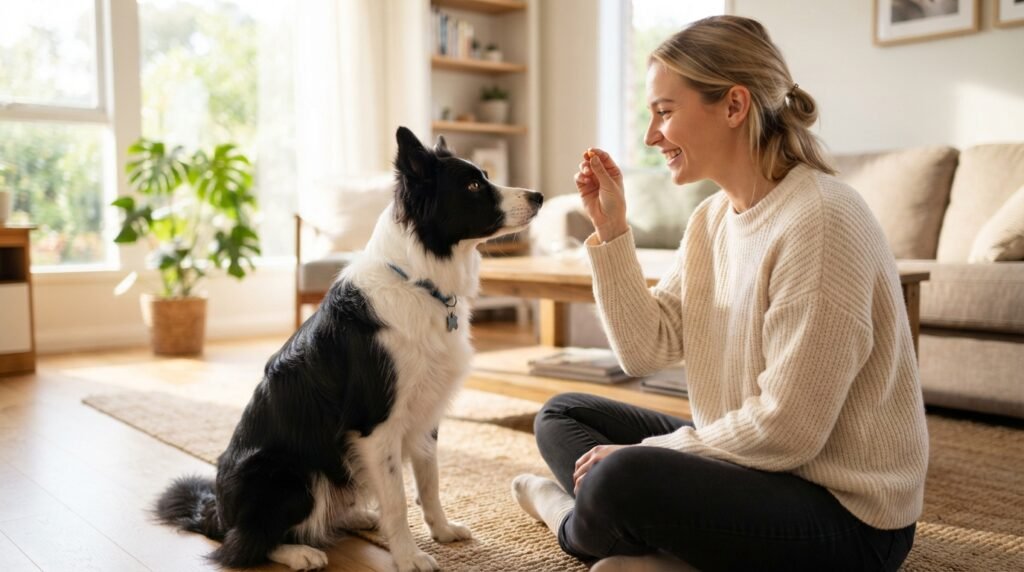
When your dog looks toward you, immediately reward them with praise or a small training treat.
Repeat this several times.
You are teaching your dog:
“When I pay attention to my owner, good things happen.”
Once your dog understands the game indoors, practice in a quiet outdoor location.
Gradually introduce more distractions.
Do not expect a dog that has mastered the exercise in your living room to immediately perform perfectly in a busy park.
Training should progress from easy environments to more challenging ones.
3. Start Training Before You Leave the House
Many owners begin leash training only after they step outside.
But you can start before opening the front door.
If your dog becomes extremely excited as soon as you pick up the leash, pause.
Wait for a moment of calm behavior.
When your dog settles, reward them.
You can repeat this while:
- Picking up the leash.
- Putting on the harness.
- Walking toward the door.
- Opening the door.
- Stepping outside.
This teaches your dog that calm behavior—not frantic excitement—is what moves the walk forward.
You don’t need to demand perfect obedience. Even a few seconds of calm behavior can be a useful starting point.
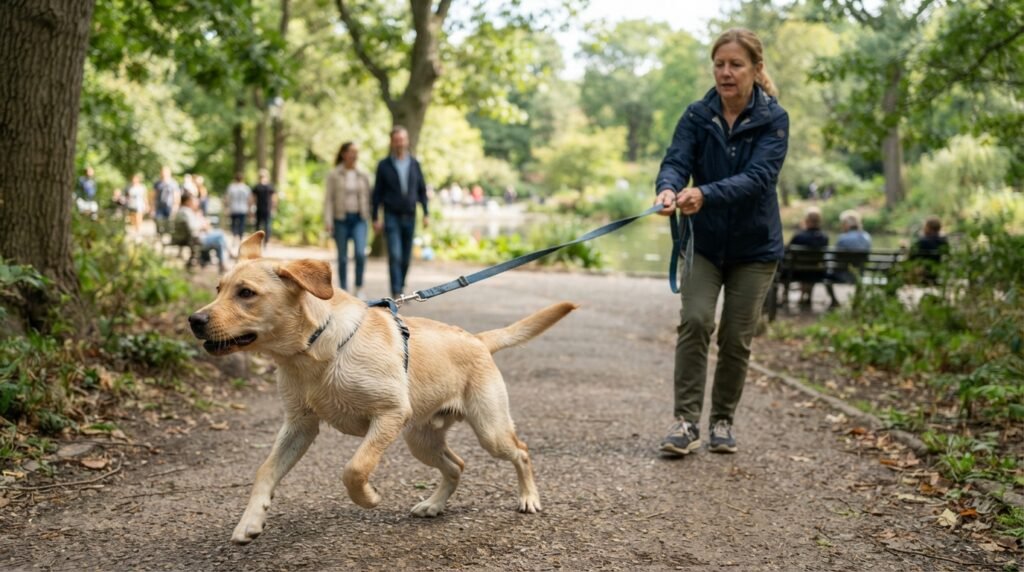
4. Reward Your Dog for Walking Beside You
One of the most effective ways to improve leash behavior is to reward the behavior you actually want.
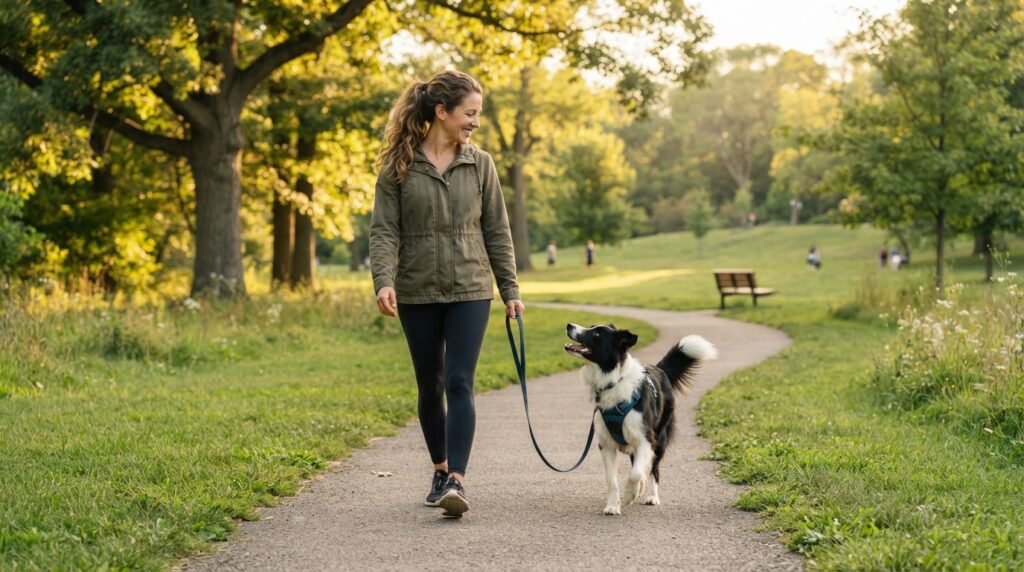
If your dog walks beside you with a loose leash, praise them.
You can use small treats, verbal praise, or another reward your dog values.
For example, take several steps.
If the leash remains loose:
“Good!”
Then reward your dog.
Over time, your dog begins to understand that staying near you has benefits.
The timing matters.
Try to reward your dog while they are displaying the desired behavior rather than waiting until several minutes later.
5. Stop Moving When the Leash Becomes Tight
This is a simple technique, but consistency is extremely important.
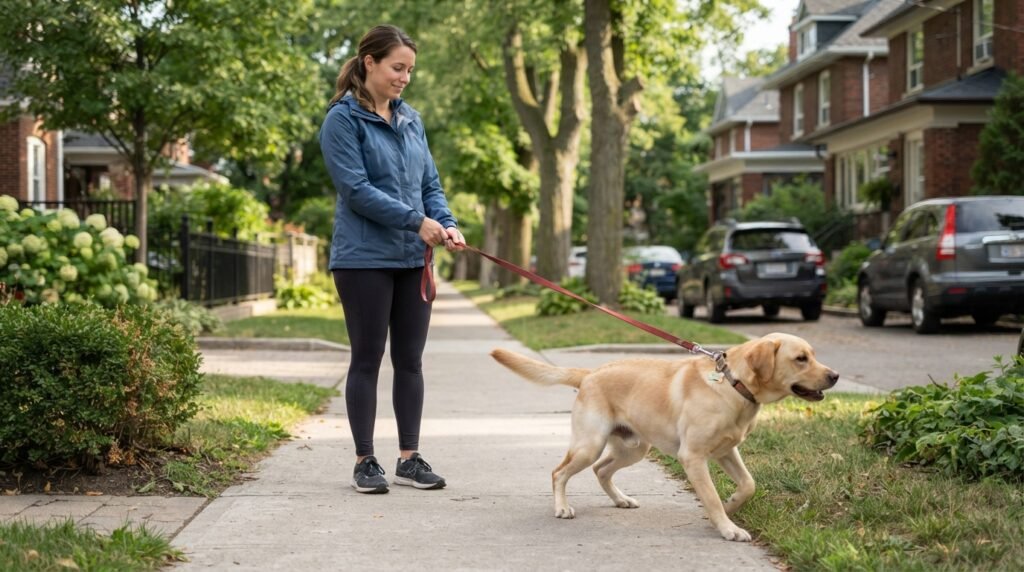
When your dog pulls forward and the leash becomes tight, stop walking.
Do not continue moving toward whatever your dog wants.
Wait for your dog to reduce the tension.
As soon as the leash becomes loose again, continue walking.
Your dog gradually learns:
Tight leash = walking stops.
Loose leash = walking continues.
This method requires patience.
If you sometimes stop when your dog pulls but other times allow them to drag you forward, the lesson becomes confusing.
Everyone who walks your dog should ideally follow the same basic rules.
What If My Dog Pulls Even Harder?
Some dogs will initially pull harder when you stop.
This can happen because the dog has previously learned that pulling eventually works.
If pulling has worked for months, your dog may not immediately understand why it suddenly stopped working.
Remain calm.
Avoid turning the walk into a physical battle.
Instead, wait for a moment of reduced tension, encourage your dog back toward you, and reward calm behavior.
If your dog is extremely strong, reactive, frightened, or difficult to control safely, professional help from a qualified reward-based trainer may be appropriate.
6. Change Direction Before Your Dog Gets Too Far Ahead
Another useful exercise is changing direction.
When your dog begins moving too far ahead, calmly turn and walk in another direction.
You can encourage your dog to follow you using their name or a cheerful verbal cue.
When they return their attention to you, reward them.
This teaches your dog that you are worth paying attention to during the walk.
Practice this in a quiet area before attempting it around heavy distractions.
Avoid jerking the leash or making sudden aggressive movements. The purpose is to teach your dog to notice where you are going, not to frighten them.
7. Give Your Dog Opportunities to Sniff
A common mistake is expecting dogs to walk continuously without stopping.
For many dogs, sniffing is one of the most rewarding parts of going outside.
Instead of fighting against this natural behavior, use it as part of training.
You might walk calmly for a short distance and then give your dog permission to sniff.
For example:
“Let’s go.”
Walk together.
Then:
“Go sniff.”
Allow your dog a short period to investigate.
This can make walks more satisfying while also teaching your dog that calm walking can lead to opportunities they enjoy.
A successful walk does not have to mean walking quickly from one location to another.
For a dog, the smells along the way are often the entire point.

8. Keep Training Sessions Short
Dogs can lose focus when training goes on for too long.
Instead of trying to fix leash pulling during one exhausting walk, practice small skills regularly.
For example, spend five minutes practicing:
- Looking at you.
- Walking beside you.
- Responding to their name.
- Stopping when the leash becomes tight.
- Changing direction.
- Walking past mild distractions.
Short, successful sessions can be more productive than long sessions filled with frustration.
End training on a positive note whenever possible.
9. Exercise Your Dog Appropriately
Sometimes a dog arrives at the leash already overflowing with energy.
That does not mean you should exhaust your dog before every walk, but appropriate physical and mental activity can help.
Depending on your dog’s age, health, and breed, useful activities may include:
- Playing fetch.
- Gentle games.
- Food puzzles.
- Basic obedience practice.
- Scent games.
- Appropriate exercise.
Mental stimulation can be particularly valuable.
A dog that has spent time thinking, sniffing, and solving simple problems may find it easier to focus during training.
However, exercise needs vary greatly between dogs. Puppies, senior dogs, and dogs with health problems may require different routines.
10. Be Patient and Consistent
Perhaps the most important lesson is patience.
Your dog did not develop leash pulling overnight, so you should not expect the habit to disappear after one training session.
Some dogs improve quickly.
Others need weeks or months of consistent practice.
Progress may also be uneven.
Your dog might walk beautifully in a quiet neighborhood but pull again when they see another dog.
That does not mean the training has failed.
It means the distraction is currently too difficult.
Move back to an easier environment and gradually build up again.
The key is to focus on improvement rather than perfection.
Final Thoughts
Learning how to stop a dog from pulling on the leash takes time, but it is absolutely possible for many dogs with consistent, reward-based training.
Start in a quiet environment, teach your dog to pay attention to you, reward loose-leash walking, and avoid accidentally rewarding pulling.
Most importantly, remember that walks should be enjoyable. Your dog needs opportunities to explore, sniff, and experience the world safely.
With patience and consistency, those stressful walks can gradually become calmer, more controlled, and much more enjoyable for both of you.
A Simple 7-Day Plan to Stop Leash Pulling
If your dog has been pulling for a long time, having a simple daily routine can make training much easier. You do not need to spend hours practicing. A few focused minutes each day can help your dog understand what you expect.
Day 1: Build Attention
Start somewhere quiet, such as your living room or backyard.
Say your dog’s name. When they look at you, immediately praise them and offer a small reward.
Repeat this several times.
The goal is to make your dog’s name meaningful. You want your dog to learn that checking in with you is worthwhile.
Keep the session short and positive.
Day 2: Practice With the Leash Indoors
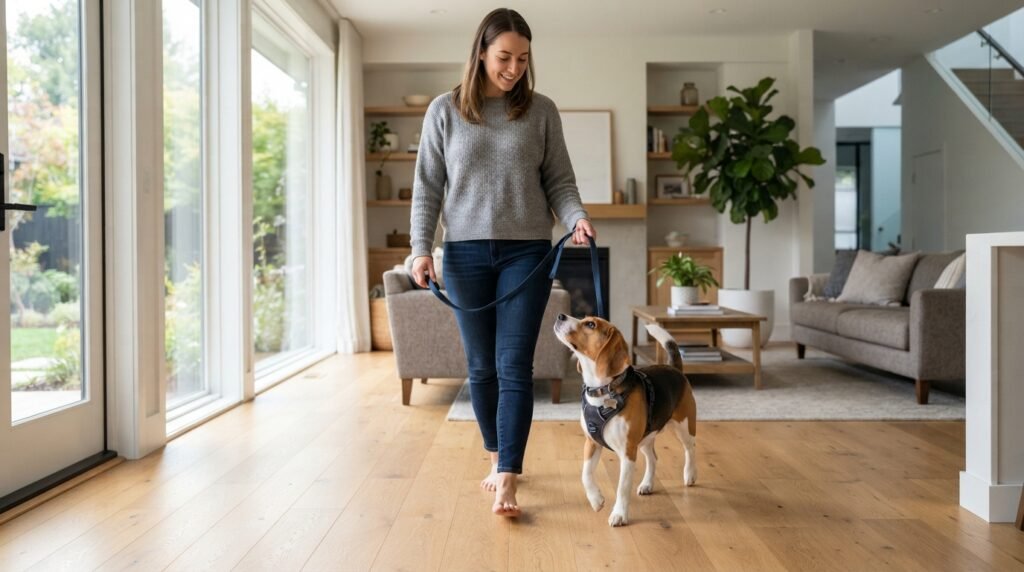
Put your dog’s normal walking equipment on.
Allow your dog to walk around the house while you hold the leash loosely.
Reward your dog whenever they stay near you without pulling.
Walk a few steps, stop, change direction, and reward your dog for following.
There is no need to rush.
You are introducing the idea that the leash does not mean your dog gets to drag you wherever they want.
Day 3: Move to a Quiet Outdoor Area
Take your dog somewhere with minimal distractions.
Begin with the attention exercise from Day 1.
Then walk a short distance.
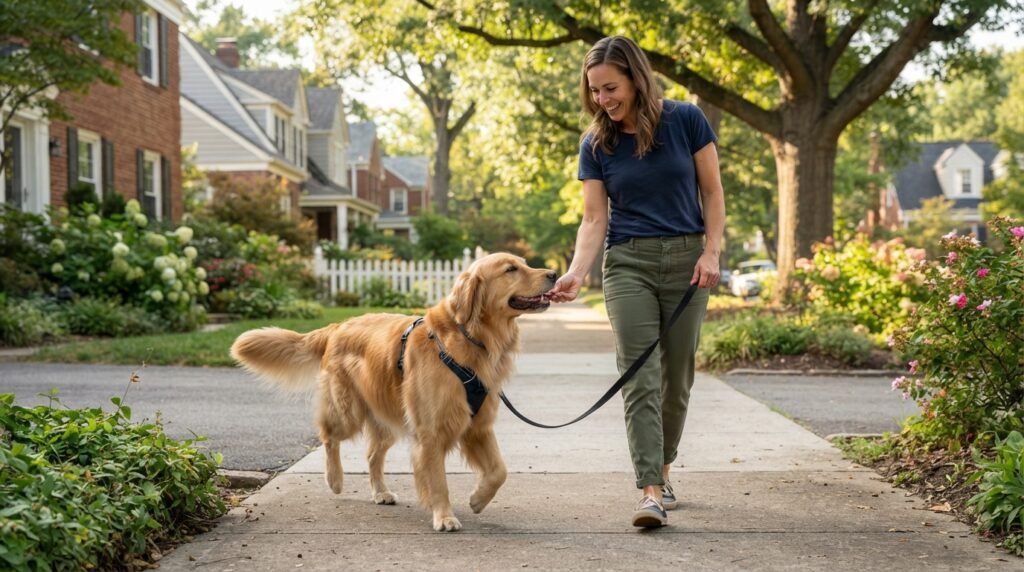
Whenever your dog walks with a loose leash, reward them.
If the leash becomes tight, stop moving and wait for the tension to disappear.
Keep expectations realistic.
Your dog does not need to walk perfectly for the entire session.
Day 4: Introduce Direction Changes
During your walk, occasionally change direction.
Use a cheerful voice to encourage your dog to follow you.
When they turn toward you, praise and reward them.
This teaches your dog to pay attention to your movement rather than automatically rushing ahead.
Practice several times without making the session confusing or frustrating.
Day 5: Add Mild Distractions
Now gradually increase the difficulty.
You might practice near a quiet park, residential street, or another location where there are mild distractions.
Keep enough distance from distractions so your dog can still focus.
If your dog becomes too excited to listen, move farther away.
Training should happen at a level where your dog can succeed.
Day 6: Practice Around More Interesting Things
Once your dog is improving, introduce slightly stronger distractions.
Your dog might see another person, hear a bicycle, notice another dog, or encounter an interesting smell.
Do not immediately walk directly toward the distraction.
Instead, reward your dog for looking at you and remaining calm.
The goal is to teach your dog that exciting things do not automatically mean pulling.
Day 7: Combine Everything
On the final day, combine the skills you’ve practiced:
- Attention
- Loose-leash walking
- Stopping when pulling begins
- Direction changes
- Rewarding calm behavior
- Controlled exposure to distractions
- Sniffing and exploration
Keep the walk enjoyable.
Remember that the seven-day plan is only a starting point. Your dog may need several more weeks of practice before loose-leash walking becomes a reliable habit.
Common Leash-Training Mistakes
Even when owners have good intentions, certain mistakes can slow progress.
Expecting Instant Results
One of the biggest mistakes is expecting a dog to stop pulling after one or two walks.
Dogs learn through repetition.
If pulling has been reinforced for months or years, changing the behavior takes time.
Celebrate small improvements.
If your dog pulls 20 times during a walk today and only pulls 15 times next week, that is still progress.
Giving Too Many Commands
Repeating “stop,” “no,” “heel,” and your dog’s name over and over can make your communication unclear.
Instead, choose a few simple cues and use them consistently.
Your dog should have a clear understanding of what behavior earns a reward.
Pulling Back on the Leash
When a dog pulls forward, many owners instinctively pull backward.
Unfortunately, this can create a constant tug-of-war.
Instead of trying to overpower your dog, focus on teaching them that a loose leash makes good things happen.
Training Only During Long Walks
A long walk is not always the best place to learn a new skill.
Start with short training sessions when distractions are manageable.
Once your dog understands the behavior, gradually practice it during normal walks.
Moving Too Quickly to Busy Areas
A dog that can walk calmly in your backyard may struggle badly on a busy sidewalk.
That is normal.
Increase distractions gradually.
If your dog cannot respond to you, the environment may simply be too difficult at that moment.
What About Puppies?
Puppies need patience.
They are still learning how the world works, and everything outside can be fascinating.
Start with very short sessions.
Reward your puppy for staying close to you rather than expecting a perfect heel.
Allow appropriate sniffing and exploration.
Avoid turning every outdoor experience into a strict training session.
A puppy should learn that walks are safe, enjoyable experiences.
As your puppy grows, you can gradually increase the length and difficulty of training.
What About a Strong Adult Dog?
Large or powerful dogs can be challenging because pulling can become physically difficult for the person holding the leash.
Do not rely solely on your strength.
Use suitable, properly fitted equipment and focus on training.
If you cannot safely control your dog, avoid situations where they could drag you into traffic, toward another animal, or into another dangerous situation.
A qualified reward-based trainer can help you create a training plan suited to your dog’s behavior.
When Should You Get Professional Help?
Most basic leash training can be practiced at home, but professional help is worthwhile when the problem involves serious fear, aggression, lunging, or reactivity.
Consider seeking professional guidance if your dog:
- Lunges aggressively at people.
- Repeatedly attacks or attempts to attack other dogs.
- Cannot be physically controlled safely.
- Becomes extremely frightened outdoors.
- Bites or redirects aggression toward the person holding the leash.
- Suddenly develops severe walking problems.
- Shows signs of pain while walking.
A veterinarian can also help rule out medical problems when a dog’s behavior changes suddenly.
For behavioral training, look for a qualified professional who uses humane, reward-based methods.
The Most Important Lesson
Leash training is not about making your dog walk like a robot.
Your dog should still be able to sniff, explore, investigate safe surroundings, and enjoy being outside.
The goal is simply to create a partnership where your dog understands how to move with you without constantly pulling.
When you consistently reward calm behavior, prevent pulling from getting your dog what they want, and gradually introduce distractions, your dog has a much better opportunity to learn.
Some days will be easier than others.
That is normal.
Stay patient, keep sessions manageable, and focus on steady improvement.
A calm walk does not happen because a dog suddenly decides to behave. It happens because the dog has been taught, practiced, and rewarded for the behavior you want to see.
Frequently Asked Questions About Dog Leash Pulling
How long does it take to stop a dog from pulling?
There is no exact timeline because every dog is different. Some dogs show noticeable improvement within a few training sessions, while others need several weeks or longer.
Age, temperament, previous training, distractions, and consistency all affect progress.
The most important thing is to practice regularly rather than expecting immediate perfection.
Should I stop walking when my dog pulls?
Stopping when the leash becomes tight can be a useful training technique. It helps your dog learn that pulling does not make the walk move forward.
Once the leash becomes loose again, you can continue walking and reward your dog for staying closer to you.
Consistency is important. If pulling sometimes gets your dog where they want to go, they may continue trying it.
Is a harness better than a collar for a pulling dog?
A properly fitted harness can provide useful control for some dogs, particularly dogs that pull strongly. However, equipment alone will not teach loose-leash walking.
The most important part is teaching your dog what behavior you want.
If you’re unsure whether a collar or harness is appropriate for your dog, ask your veterinarian or a qualified dog-training professional.
Should I let my dog sniff during walks?
Yes. Sniffing is a natural and enriching activity for dogs.
Instead of trying to prevent every sniff, you can make sniffing part of your walking routine.
For example, reward your dog for walking calmly for a short distance and then give them permission to investigate a safe area.
This can make walks more enjoyable while teaching your dog that calm behavior leads to rewarding experiences.
What should I do if my dog pulls toward another dog?
Create more distance before your dog becomes overly excited.
Use your dog’s name and encourage them to focus on you. Reward calm behavior.
If your dog cannot respond because they are already too excited, move farther away.
Do not force your dog into a close interaction simply because another dog is approaching.
Can older dogs learn to stop pulling?
Yes. Older dogs can learn new walking habits.
They may require more patience if pulling has been reinforced for years, but age does not automatically prevent learning.
Keep training sessions manageable and consider your dog’s physical abilities.
If an older dog suddenly begins pulling, resisting the leash, or behaving differently, a veterinary check may be appropriate because pain or another health problem could affect walking behavior.
A Simple Rule to Remember
When training your dog to walk nicely, remember this simple principle:
Reward the behavior you want to see.
If your dog walks calmly, reward them.
If they check in with you, reward them.
If they return to your side, reward them.
If they keep the leash loose, reward them.
Over time, your dog learns which behaviors lead to positive outcomes.
Make Walks About More Than Distance
Many owners think a successful walk means covering a certain number of miles.
For dogs, however, the quality of the experience can be just as important as the distance.
A short walk with plenty of safe sniffing, exploration, and positive interaction can be more valuable than a long walk filled with constant pulling and frustration.
Try to think of walks as opportunities for exercise, enrichment, training, and bonding.
Final Thoughts
Teaching a dog to stop pulling on the leash requires patience, consistency, and realistic expectations.
Start somewhere quiet and make the training easy enough for your dog to succeed. Reward loose-leash walking, teach your dog to pay attention to you, and gradually introduce more challenging distractions.
Avoid turning every walk into a battle.
Your dog is not necessarily trying to be difficult. Pulling is often a behavior that has been learned because it has worked in the past.
Your job is to teach your dog that there is a better way.
With regular practice, many dogs can become much easier and more enjoyable to walk.
The result is not just better leash manners. It can mean safer walks, less stress, better communication, and more enjoyable time together.
A calm walk starts with small steps.

hammadniazi6663@gmail.com
Contributor at PetZuoo, publishing practical information for pet owners and animal lovers.
Related guides
Why Do Dog Tilt Their Heads? 9 Fascinating Reason
Why Do Dog Tilt Their Heads? 9 Fascinating Reason Behind This Adorable Behavior. Have you ever spoken to your dog and watched…
Why Does Dog Suddenly Follow Me Everywhere? 9 Reasons
Why Does Dog Suddenly Follow Me Everywhere? 9 Reasons and Have you noticed that your dog suddenly seems to be your shadow?…
Ultimate Guide to Dog Separation Anxiety
Ultimate Guide to Dog Separation Anxiety. Proven Ways to Help Your Dog Feel Safe Alone, and Leaving your dog at home for…